





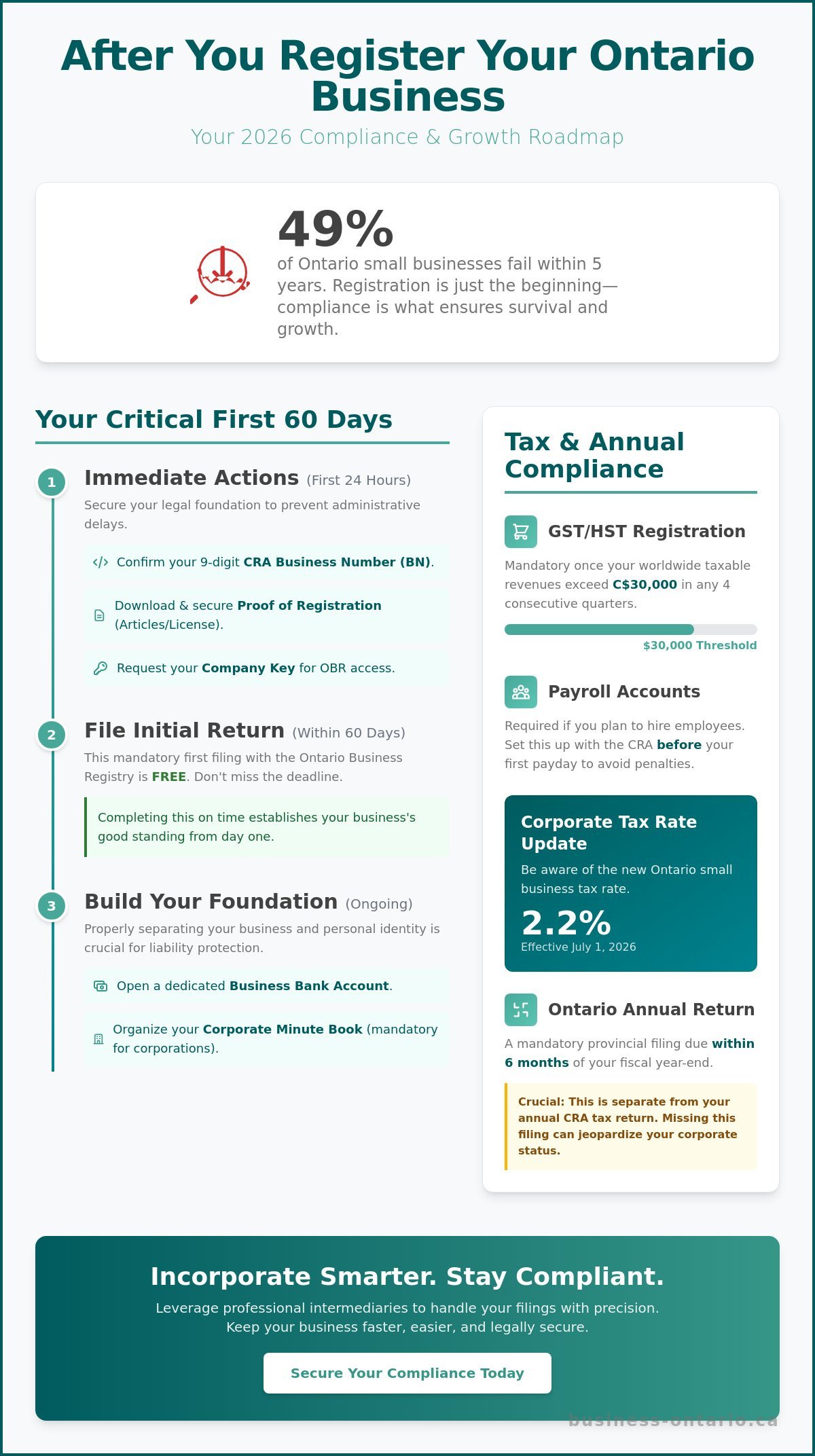
Did you know that 49% of small businesses in Ontario fail within their first five years? While you’ve successfully secured your business name, the real work begins now to ensure you don’t become part of that statistic. Knowing exactly what to do after registering a business in Ontario is the critical difference between a high-growth company and one buried in CRA penalties. Registration is the birth of your business, but compliance is the oxygen that keeps it alive and legally protected.
You’re likely feeling the pressure of balancing provincial filings with federal tax obligations. It’s common to worry about missing a deadline or choosing the wrong financial structure for your corporate hygiene. We understand the need for clarity. This guide provides a prioritized roadmap to secure your legal standing and protect your personal assets. We will walk you through every essential 2026 milestone, from filing your free Initial Return within 60 days to navigating the new 2.2% small business tax rate effective July 1, 2026. Follow these steps to incorporate smarter and ensure your venture remains faster, easier, and legally secure.
Key Takeaways
- Secure your Business Number and digital registration documents immediately to establish your legal foundation. This is the critical first step in knowing what to do after registering a business in Ontario to avoid administrative delays.
- Separate your personal and business finances by opening a dedicated business bank account. For corporations, organizing your Minute Book is a mandatory legal requirement that protects your limited liability status.
- Evaluate the C$30,000 revenue threshold for mandatory GST/HST registration and set up payroll accounts if you plan to hire employees. Proactive tax account management ensures you avoid costly CRA penalties.
- Schedule your mandatory Annual Return filing with the Ontario Business Registry to remain compliant. This legal requirement is distinct from your corporate tax return and must be completed within six months of your fiscal year-end.
- Leverage professional intermediaries to handle address or director changes with precision. Outsourcing these filings ensures your corporate hygiene remains faster, easier, and legally secure.
Immediate Actions: The First 24 Hours After Ontario Registration
The clock starts the moment your application is approved. Knowing what to do after registering a business in Ontario within the first 24 hours prevents administrative bottlenecks that stall your launch. Your priority is to transition from a successful applicant to a legally compliant operator. This requires securing your digital footprint and establishing your identity with federal authorities immediately. Efficiency at this stage protects your personal assets and sets a professional tone for your operations.
Confirming Your CRA Business Number
Your Business Number (BN) is a unique 9-digit identifier that serves as your permanent account number for all federal tax interactions. It’s the foundation of your relationship with the Canada Revenue Agency (CRA). While many sole proprietorships receive this instantly, Ontario provincial corporations often face a specific 4-day wait time before the BN is fully synchronized between the provincial registry and the federal database. Don’t confuse the BN with specific program accounts. The BN is your identity; program accounts like GST/HST (RT) or Payroll (RP) are specific services attached to that identity. You’ll need this number to open bank accounts or sign contracts, so verify its issuance through your registration dashboard or the CRA online portal without delay.
Securing Your Proof of Registration
Your official documents are the “birth certificates” of your enterprise. For sole proprietorships, this is your Master Business License. For corporations, you’ll receive your Articles of Incorporation. Download these digital files and store them in multiple secure locations immediately. These documents are governed by the broader framework of Canadian corporate law, which dictates how your entity must be structured and maintained. Additionally, keep your NUANS Name Search Report with these records. This report is your primary evidence of name protection and search diligence. It’s vital if trademark or trade name disputes arise in the future.
Activating Your Ontario Business Registry Access
Since October 2021, the Ontario Business Registry (OBR) has been the digital hub for all corporate filings. You must request your Company Key immediately. This unique code is required to access your profile, file your free Initial Return within 60 days, or update your address. Set up a secure digital filing system now to organize all government correspondence. Use a dedicated cloud folder or encrypted drive to store your Company Key, Articles, and BN confirmation. This level of corporate hygiene ensures your business remains faster, easier, and legally secure from day one. Proper organization today prevents the anxiety of missed deadlines tomorrow.
Setting Up Your Financial and Legal Infrastructure
Setting up your financial and legal infrastructure is the shield that protects your personal assets from business liabilities. Once you have your registration documents in hand, the next critical step in what to do after registering a business in Ontario is to separate your identities. Mixing personal and business funds, a practice known as commingling, is a primary reason courts “pierce the corporate veil.” This leaves you personally liable for business debts and legal judgments. Establishing a clear boundary between your personal life and your business entity is essential for long-term security.
Business Banking in the GTA
Financial institutions in the GTA, especially in high-traffic hubs like Toronto and North York, enforce strict compliance standards for commercial accounts. You cannot use a personal bank account for a registered business name. It lacks the legal capacity to hold funds for a separate entity and complicates your tax filings. When you visit a branch, bring your Articles of Incorporation or Master Business License, your 9-digit CRA Business Number, and valid government ID. Secure a dedicated business credit card during this visit. This keeps your expenses organized, making it significantly simpler when it’s time to file your GST/HST return and claim input tax credits.
The Corporate Minute Book Requirement
If you’ve chosen to incorporate, maintaining a Corporate Minute Book is a legal mandate under the Ontario Business Corporations Act. This record serves as the official history of your corporation. It must contain your Bylaws, Director and Officer Registers, and Shareholder Ledgers. Without these records, your corporation doesn’t legally exist in the eyes of the government or potential investors. Failing to record shareholder resolutions or issue initial share certificates can invalidate your corporate protection during an audit. Business Ontario offers streamlined solutions to help you organize these records, ensuring your corporate hygiene is faster, easier, and legally secure.
Equity and Internal Agreements
Formalize your business relationships immediately to prevent future disputes. If you’re operating with partners, a Partnership Agreement or Shareholders Agreement is non-negotiable. These documents outline decision-making power, profit distribution, and exit strategies. Statistics Canada indicates that roughly 49% of Ontario small businesses fail within five years; a significant portion of these failures are due to internal conflict. Issue your initial shares and record the resolutions today. This establishes clear ownership from the start and provides the legal certainty needed to grow your venture with confidence. Addressing these infrastructure needs now is the smartest way to protect what you’ve built.
Tax Accounts and Municipal Licensing Checklist
Securing your provincial registration is a milestone, but it doesn’t grant you a blanket permit to operate. Navigating federal tax obligations and local bylaws is the next phase in what to do after registering a business in Ontario. Missing these steps can lead to immediate fines from the CRA or a cease-and-desist order from your municipality. You must ensure your business is synchronized with every level of government to remain faster, easier, and legally secure.
CRA Program Accounts: GST/HST and Payroll
You must Register for a Business Number and CRA accounts to handle GST/HST and payroll. The CRA classifies businesses with annual revenues under C$30,000 as “Small Suppliers,” meaning registration is optional. However, voluntary registration is often the smarter move. It allows you to claim Input Tax Credits (ITCs) on your startup expenses, effectively recovering the HST you’ve paid on equipment and services. If you plan to hire staff or pay yourself a salary as an active director, you’ll need a Payroll account (RP) immediately. For a deeper look at managing these obligations, consult our Accounting and Compliance guide.
Workplace Safety and Insurance Board (WSIB)
If your business employs anyone, including family members or part-time staff, you must register with the WSIB within 10 days of hiring. For 2026, the average premium rate is C$1.23 per C$100 of insurable payroll, with an earnings ceiling of C$121,700. This isn’t just a fee; it’s a critical legal shield. WSIB coverage prevents employees from suing you for workplace injuries, protecting your corporate assets and personal peace of mind. Some industries, such as construction, have mandatory coverage requirements even for independent operators without staff.
Local Municipal Licenses in the GTA
A provincial registration does not override municipal requirements. In cities like Toronto or North York, specific industries require a separate municipal business license to operate legally. This includes food services, hair salons, and general contractors. Before you sign a commercial lease in Vaughan, Mississauga, or Oakville, check the local zoning bylaws. A space might look perfect, but if the zoning doesn’t permit your specific business type, your provincial registration won’t save you from a shutdown. Always verify that your physical location is compliant with city-specific regulations before opening your doors to the public.
Ongoing Compliance: Managing the Ontario Business Registry
Maintaining your standing with the Ontario Business Registry (OBR) is a continuous obligation. Many entrepreneurs mistakenly believe that registration is a one-time event. In reality, staying active requires a proactive approach to corporate hygiene. Understanding what to do after registering a business in Ontario involves tracking specific provincial deadlines that are entirely separate from your federal tax filings. Neglecting these tasks can lead to the involuntary dissolution of your company, stripping you of your limited liability protection and legal right to operate.
The Mandatory Annual Return
Every corporation in Ontario must file an Annual Return. It’s vital to understand that this is not a tax return. While the CRA handles your finances, the OBR requires this document to confirm your corporation’s current directors and head office address. You must file this return within six months of your corporation’s fiscal year-end. Failing to meet this deadline puts your business at risk of being struck off the registry. To ensure your status remains active without the administrative burden, you can use our Annual Return Filing service. This proactive step keeps your business faster, easier, and legally secure.
Reporting Changes to the Corporation
Your corporate profile must always reflect the current reality of your business. Ontario law mandates a strict 15-day window for reporting any changes to your corporation’s information. This includes appointing new directors, recording resignations, or moving your head office to a new location. You must file a Notice of Change through the OBR to document these updates. Business Ontario acts as an official intermediary for these filings, providing a streamlined path to compliance that bypasses government bureaucracy. Keeping these records accurate is essential for maintaining your credibility with banks and provincial authorities.
Managing Business Name Renewals
If you’re operating as a sole proprietorship or a partnership, your Master Business License isn’t permanent. These registrations expire every five years. You must monitor your renewal date closely to ensure your brand identity remains protected. If you decide to change your brand name or pivot your business model, you’ll likely need a new Nuans report to verify name availability and prevent trademark conflicts. Transitioning your brand without updating the registry can lead to significant legal liability. Managing these updates with precision ensures your venture continues to operate at the speed of modern commerce. If you need to update your corporate records today, file your Notice of Change now to protect your assets.
Incorporate Smarter: Why Professional Maintenance Matters
The true test of a successful entrepreneur isn’t just the initial registration; it’s the consistent maintenance that follows. Many business owners fall into the trap of “DIY” corporate upkeep, only to realize too late that they’ve missed a critical provincial deadline or filed incorrect information. Understanding what to do after registering a business in Ontario requires a shift from a launch mindset to a compliance mindset. Relying on an Official Intermediary of Service Ontario ensures that your records are handled with precision, keeping your operations faster, easier, and legally secure.
Protecting Your Corporate Veil
Maintaining your corporate veil is the only way to ensure your personal assets remain shielded from business liabilities. This protection isn’t automatic. It requires meticulous record-keeping and timely filings. If your minute book is empty or your director information is outdated, you risk losing the limited liability status that incorporation provides. Professional filings build immediate credibility with investors and financial institutions in the GTA. When banks see a perfectly maintained corporate history, they’re more likely to approve lending and credit facilities. This is why we’re trusted by 10,000+ entrepreneurs who prioritize legal security over administrative guesswork. Proper corporate hygiene is the foundation of a resilient enterprise.
As your business grows, your needs will evolve. You might start as a sole proprietorship to test the market, but scaling often requires transitioning to a corporation to access the lower small business tax rate. This rate is proposed to drop to 2.2% on July 1, 2026, for the first C$500,000 of active business income. This transition involves more than just a name change; it requires a complete legal restructuring and new tax account setups. Navigating this shift alone increases the risk of CRA penalties or administrative errors that can take months to resolve. By choosing to incorporate smarter, you delegate the technical complexity to experts, allowing you to focus on revenue and growth.
Next Steps with Business Ontario
Your journey doesn’t end with a certificate of incorporation. We provide the long-term support necessary to navigate the complexities of Ontario’s regulatory environment. If you’re planning to expand your brand or launch a new product line, start with a professional Nuans Name Search to secure your intellectual property. Don’t wait for a government notice to find out you’re non-compliant. Visit the Business Ontario homepage today for a comprehensive compliance audit. We provide the direct tools and expert guidance needed to ensure your business remains in good standing year after year. Secure your legacy by making compliance a priority from day one.
Secure Your Corporate Future Today
You’ve moved beyond the registration phase. Now, you must focus on the rigorous maintenance required to stay active and compliant. Statistics Canada reports that 49% of Ontario small businesses fail within five years; often due to avoidable administrative errors or legal oversights. Securing your corporate veil through a Minute Book and filing your Initial Return within 60 days are non-negotiable steps for every new founder. Understanding exactly what to do after registering a business in Ontario ensures you remain protected under provincial law while maximizing tax efficiencies like the 2.2% small business rate scheduled for July 1, 2026.
Don’t let bureaucracy slow your growth or increase your anxiety. As an Official Intermediary of Service Ontario, we provide 1-Business Hour processing for most filings to keep you moving at the speed of modern commerce. We’re already trusted by 10,000+ entrepreneurs to handle the technical complexities of the Ontario Business Registry with expert precision. Incorporate Smarter and Stay Compliant with Business Ontario today to protect your assets. Your vision deserves a faster, easier, and legally secure foundation. Build your legacy with confidence.
Frequently Asked Questions
How long do I have to open a bank account after registering my business in Ontario?
You should open a business bank account immediately after receiving your registration documents. While there’s no statutory deadline, you can’t legally accept payments or sign commercial contracts in your business name without one. Mixing funds is a primary reason 49% of small businesses fail within five years. Banks in Toronto require your Articles of Incorporation or Master Business License and your 9-digit Business Number to proceed.
Do I need a GST/HST number immediately after registration?
You only need a GST/HST number immediately if you expect your gross revenue to exceed C$30,000 within four consecutive quarters. However, registering early is a smart move to claim Input Tax Credits on initial startup costs. If you’re hiring staff or paying a director’s salary, you must set up your CRA program accounts regardless of revenue. This is a vital step in what to do after registering a business in Ontario to ensure tax compliance.
What is the difference between a Business Number and an Ontario Corporation Number?
Your Business Number (BN) is a 9-digit federal identifier issued by the CRA for tax purposes. In contrast, your Ontario Corporation Number (OCN) is a 7-digit provincial ID assigned by the Ontario Business Registry. The OCN identifies your legal entity within the province, while the BN is your identity for all federal tax interactions. You’ll need both to maintain proper corporate hygiene and legal standing.
What happens if I forget to file my Ontario Annual Return?
Forgetting to file your Annual Return within six months of your fiscal year-end can lead to the involuntary dissolution of your corporation. The Ontario government has the authority to strike your business off the registry for non-compliance. It’s a risk that leads to the loss of your limited liability protection. We recommend using an official intermediary to automate these filings and prevent administrative termination.
Can I change my business address online after I have already registered?
Yes, you can and must update your business address online through the Ontario Business Registry. Provincial law requires you to file a Notice of Change within 15 days of moving your head office. It’s essential to ensure that all official government correspondence reaches your business. Filing these updates through a licensed intermediary makes the process faster, easier, and legally secure.
How do I renew my Ontario Master Business License in 2026?
You must renew your Ontario Master Business License every five years through the Ontario Business Registry. In 2026, the process remains fully digital and requires your Company Key for access. If your license expires, you’ll lose the legal right to use that business name. This could lead to another entrepreneur claiming it. Monitor your expiry date closely to maintain your brand’s legal standing in the GTA.
Is a Minute Book mandatory for every small business in Ontario?
A Minute Book is a mandatory legal requirement for all incorporated businesses under the Ontario Business Corporations Act. It isn’t required for sole proprietorships. This record must include your bylaws, director registers, and share certificates. Maintaining an accurate Minute Book is the only way to prove your corporation is a separate legal entity. It’s essential during a CRA audit or when seeking investment to protect your personal assets.
What local licenses do I need to operate in Toronto or North York?
Local licensing depends entirely on your industry and specific location in Toronto or North York. While provincial registration doesn’t cover every permit, the City of Toronto requires separate licenses for roughly 100 different business categories. This includes food establishments and building renovators. Always verify your zoning compliance before signing a lease. This is a critical part of what to do after registering a business in Ontario to avoid municipal fines.