

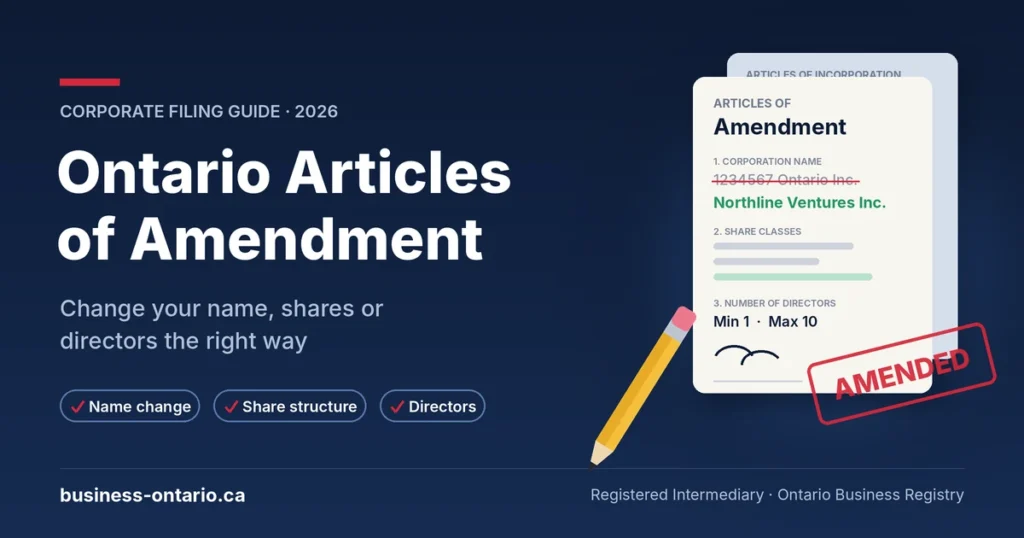
Articles of Amendment in Ontario
Change your corporation’s legal name, share structure or other provisions in its articles. Business Ontario helps prepare and file your Articles of Amendment, with clear guidance on the information and approvals needed. +
Change your corporation’s legal name, share structure or other provisions in its articles. Business Ontario helps prepare and file your Articles of Amendment, with clear guidance on the information and approvals needed.
- Ontario corporation filings
- Document preparation
- Online ordering
Corporate Name Changes
Share Structure Changes
Director Number Changes
Other Article Provisions
Articles of Amendment: a plain-English guide
When you incorporated, you chose a name, set up your shares and decided how your corporation would operate. A few years later, you may be rebranding, welcoming an investor or making room for more directors. Your articles should reflect those changes.
Articles of Amendment are the official filing used to change provisions in an Ontario business corporation’s articles. They can update the legal name, share structure, director limits and other rules under Ontario’s Business Corporations Act (OBCA).
This guide explains what you can change, which approvals to arrange, how the filing works and what to update after approval. It focuses on Ontario business corporations; federal and not-for-profit corporations follow different requirements.
What do Articles of Amendment change?
Your Articles of Incorporation are your corporation’s founding rulebook. They set out its name, authorized shares, director numbers and any restrictions on its activities or powers. Articles of Amendment change that rulebook without incorporating a new company.
Once the filing is accepted, Ontario issues a Certificate of Amendment. The amendment takes effect on the date shown on the certificate. Keep the certificate and amendment with your original articles and any earlier amendments.
Think of an amendment as changing the corporation’s legal rules. Updating a street address or reporting a new director is a different kind of filing.
Common reasons to file Articles of Amendment
You may need an amendment when your business grows, ownership plans change or an existing provision no longer fits. Common examples include:
- Changing your corporate name: switch from a numbered company to a named corporation, or adopt a new legal name as part of a rebrand.
- Restructuring shares: add a share class, introduce non-voting shares or change rights attached to existing shares.
- Changing director numbers: replace a fixed number with a minimum and maximum, or change the limits stated in the articles.
- Adding or removing share transfer restrictions: revise provisions controlling how shares may be issued, transferred or owned.
- Changing business restrictions: amend limits on the activities or powers of the corporation, including provisions relevant to a regulated practice.
- Updating other provisions: change article clauses concerning matters such as borrowing or issuing shares, where applicable.
If your change affects share rights, ownership or a professional corporation, have an Ontario lawyer and, where appropriate, a tax adviser review the wording before filing.
CHOOSE THE RIGHT FILING
Articles of Amendment vs. Notice of Change
Not every corporate update requires an amendment. Use Articles of Amendment to change provisions in the articles; use a Notice of Change to update reportable corporate information. The distinction matters when you are changing directors or moving your office.
| You want to change… | Filing usually needed |
|---|---|
| Corporate legal name | Articles of Amendment |
| Share classes, rights or conditions | Articles of Amendment |
| Fixed or minimum/maximum number of directors in the articles | Articles of Amendment |
| Share transfer restrictions, business restrictions or other article provisions | Articles of Amendment |
| Who the directors or officers are | Notice of Change |
| Registered office address within Ontario | Notice of Change |
| Official email or primary business activity code | Notice of Change / applicable OBR information update |
Filing costs, timing and what to prepare
Ontario’s government fee is $150 CAD. That is the filing fee, not the total price of a professional filing service. A NUANS report, preparation services and optional processing services can add to the cost. See the current order options for your total.
Processing: online filing is generally faster than mailing the application. Allow time for approvals, drafting and document review before submission. Business Ontario offers regular and expedited options on its order form; those timelines are estimates, not guaranteed approval dates.
Corporate records: have your exact current legal name, Ontario Corporation Number (OCN), company key and official email address ready. Include your existing articles and amendments so the proposed change can be matched to the correct provisions.
Approved instructions: provide the exact changes, resolution date, signing director or officer, contact details and preferred effective date. Clear instructions help avoid an amendment that does not match what the corporation approved.
Name changes: a new word name generally needs an Ontario-biased or weighted NUANS report dated no more than 90 days before submission. The proposed name must match the search. A change to a numbered name does not require a NUANS report.
Two filings may be needed: if you change both the permitted number of directors and the people holding office, the amendment and Notice of Change serve different purposes. Updating the legal name alone does not automatically mean you need a separate Notice of Change.
Business Ontario prepares and files amendment applications as a Registered Intermediary of the Ontario Business Registry. We can also assist with a NUANS report, a corporate name change or a related Notice of Change. Confirm the scope of your order before submission.
How to file Articles of Amendment in Ontario
Get the required approval
Most amendments require a shareholder special resolution: at least two-thirds of votes cast at a properly called meeting, or written consent from all shareholders entitled to vote. Some changes have director-resolution exceptions, and certain share changes require separate class votes. Record the appropriate approval in your minute book.
Arrange a NUANS report, if needed
If you are changing to a word name, arrange the Ontario name search and review possible conflicts. Keep the report at the registered office; provide its reference number, searched name and date with the filing. A name search does not guarantee approval or trademark rights.
Gather and review the details
Collect your OCN, company key, current articles, approved resolution date and precise amendment wording. Check that the instructions describe what is being added, removed or changed. Share restructurings deserve legal and tax review before submission.
Submit through the Ontario Business Registry
You can file through the OBR or use an intermediary such as Business Ontario. A director or officer must authorize the filing. Pay the government fee and any service or search charges that apply. A mailed application uses the approved Form 5261.
Choose the effective date
Request the filing date or a future date up to 30 calendar days ahead, subject to acceptance and a valid NUANS report where required. An amendment cannot be backdated. Coordinate the date with any financing, name change or other planned transaction.
Receive your Certificate of Amendment
After acceptance, review the certificate and amendment for the correct changes and effective date. Save them with your corporate records and complete the practical updates below. The certificate confirms the amendment; it does not update every bank, account or contract for you.
● After your filing is approved
Your amendment is approved.
Here’s what to update next.
The certificate is the official step. These practical updates help your day-to-day business catch up with the change.
01
Update your minute book
02
Review CRA account details
After a name change, notify the CRA as required and check the legal name on your Business Number, GST/HST and payroll accounts.
03
Notify your bank
Give your bank the amendment documents so account records, signing arrangements and payments reflect the change.
04
Check registrations and permits
Update affected business-name registrations (formerly called Master Business Licences), permits and your WSIB account where applicable.
05
Refresh business communications
Review your website, invoices, contracts, email signatures and signage. Tell suppliers, landlords and insurers about relevant changes.
06
Update share records
If the share structure changed, arrange the necessary share certificates and securities-register updates with your legal adviser.
Keep everything aligned
One filing.
A few follow-ups.
Skipping an account update does not undo the amendment, but it can cause payment, paperwork or communication problems later.
Need another corporate filing?
Ask our team what to arrange next.
Official resources
Information checked October 22, 2026. This page is general information, not legal or tax advice. For changes to share rights, speak with an Ontario lawyer or accountant.
Related services for your corporate changes
Rebranding or moving from a numbered company to a named corporation? Get help with the legal name change and the related filing.
Changing to a word name? Order the appropriate name search before submitting your amendment.
Update your registered office, directors or officers when the change belongs in your corporate information record.
What clients say about Business Ontario


Articles of Amendment in Ontario: frequently asked questions
How much does it cost to file Articles of Amendment in Ontario?
The Ontario government filing fee is $150 CAD. If you are changing to a word name, budget for an Ontario NUANS report as well. A filing service charges separately for its services and selected extras. Review the Business Ontario order total before checkout.
How long does it take?
Online filing is generally faster than filing by mail, but total turnaround includes preparing the amendment and obtaining approvals. Business Ontario’s order form offers regular and expedited processing options. Check the current estimate when ordering; incomplete information, corrections or additional review can cause delays.
Can I change several things in one filing?
Yes. One set of Articles of Amendment can cover several approved changes, such as a new legal name, revised share provisions and new director limits. Each change must be properly authorized and clearly described. A separate Notice of Change may still be needed for updates to corporate information.
Do I need a lawyer?
A lawyer is not required for every straightforward amendment, such as a simple name change. Legal and tax advice is important for share restructurings, changes affecting shareholder rights or regulated businesses. Filing assistance does not replace advice about the effect of the amendment.
Can I backdate an amendment?
No. You cannot choose a past effective date. You may request a future date up to 30 calendar days ahead, subject to the filing being acceptable and any required NUANS report remaining valid. The effective date is shown on the Certificate of Amendment.
Do I need Articles of Amendment to change directors?
Changing who the directors are is normally reported through a Notice of Change. Articles of Amendment are needed when you change the fixed number or minimum/maximum number written in the articles. Adding a director within an existing permitted range does not, by itself, change that range.
Do I need a NUANS report for every amendment?
No. A NUANS report is generally needed when changing to a new word name. It is not normally needed for an amendment limited to share provisions or director numbers, or for a change to a numbered name. Confirm any special name requirements before filing.
Do shareholders have to approve the amendment?
Most amendments require a shareholder special resolution. Exceptions include a directors’ resolution to change a number name to a word name under the OBCA. Some changes affecting shares can require separate class or series approval. Check the proposed amendment against your articles and the Act before proceeding.
Does an amendment create a new corporation?
No. An amendment changes the existing corporation’s articles. Keep the original incorporation records together with the Certificate of Amendment and all subsequent amendments. A name change does not mean that your existing obligations disappear.
Can a federal or not-for-profit corporation use this Ontario filing?
This guide covers Ontario business corporations under the OBCA. A federal corporation amends its articles through Corporations Canada. Ontario not-for-profit corporations use the ONCA process and the appropriate form. Tell us your incorporation jurisdiction and entity type when ordering.
What do I receive after the amendment is accepted?
You receive the Certificate of Amendment and the filed amendment documents. Check the effective date and details, then keep them in your minute book. Use the documents to update affected accounts, registrations and business records as needed.
Let us handle your Articles of Amendment
The details matter. An expired name search or unclear share provision can delay your filing. Tell us what you want to change, and our team will help prepare the application for submission.